
Framework Architecture
- Optimistic Governance: Current trend shows a 30% reduction in proposal latency across major DeFi protocols.
- Reputation Systems: Transitioning from token-weighted voting to soulbound-reputation for core protocol contributors.

Governance is the decision-making layer of every blockchain protocol. Changes in voting systems, treasury allocation, and incentive structures often influence protocol direction long before those changes are reflected in market performance.
This section analyzes DAO governance frameworks, treasury management strategies, voting participation trends, and governance-related risks across major Web3 ecosystems.
Governance frameworks determine how blockchain protocols make decisions, allocate resources, and adapt to changing market conditions. As DAO ecosystems mature, governance models are evolving beyond simple token-weighted voting toward more specialized systems that balance efficiency, participation, and long-term sustainability.
Treasury management is one of the most important indicators of DAO sustainability. Protocol treasuries must balance growth, risk management, and long-term operational runway while navigating volatile market conditions.
Diversification metrics for top DAOs show a 40% shift from native-token dominance to stablecoin-yield strategies in Q2 2026.
Governance systems can create hidden risks that are not immediately reflected in protocol performance. Concentrated voting power, low participation rates, and governance attack vectors may undermine decentralization and long-term resilience.
Data suggests ve-tokenomics lockup periods are currently trending towards 2-year average thresholds, indicating stronger long-term commitment.
Systemic tracking of proposal success rates vs. voter turnout reveals a 12% decline in participatory engagement in smaller-cap protocols.
Governance Intelligence
Evaluating blockchain protocol health requires moving past superficial marketing narratives and examining token distribution concentration, [...]

Governance Intelligence
On-Chain Tokenization Bridges Traditional Yields to Decentralized Protocol Balance Sheets The tokenization of Real World [...]

Governance Intelligence
By DAO Governance & Operations Research Group | Published for Builder-Centric Protocols Remember when launching [...]
Governance Intelligence
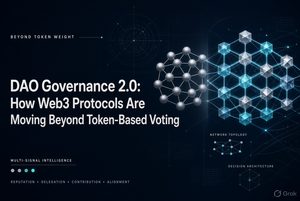
Token voting was supposed to solve a simple problem: if a blockchain protocol is decentralized, [...]
Governance Intelligence
OpenAI commits $1 billion to cybersecurity infrastructure after launching AI system capable of discovering zero-day [...]

Governance Intelligence
Analyze how the Ripple fundraising SEC waiver and regulatory mandates under SEC rules affect institutional [...]

Governance Intelligence
Analyze the regulatory impact of the March 2026 SEC/CFTC joint interpretive guidance on XRP, macro [...]

Governance Intelligence
Analyze whether is xrp deflationary based on insights from David Schwartz. We examine XRPL burn [...]

Governance Intelligence
Economic Mechanics of Governance Attacks Governance attacks represent a structural vulnerability where malicious actors acquire [...]
Governance determines how a blockchain protocol evolves over time. Decisions regarding treasury allocation, token incentives, fee structures, and network upgrades are often made through governance processes. These decisions can significantly influence protocol growth, capital efficiency, and long-term sustainability before they become visible in market performance.
An effective governance system balances decentralization with decision-making efficiency. Important factors include voter participation, proposal quality, delegate accountability, treasury transparency, and resistance to governance attacks. Strong governance frameworks allow protocols to adapt more effectively to changing market conditions.
DAO treasuries fund ecosystem development, security audits, contributor incentives, and operational expenses. Treasury diversification, stablecoin allocation, and runway management are key indicators of whether a protocol can maintain growth during both bullish and bearish market cycles.
Governance risks include voting power concentration, delegate centralization, treasury mismanagement, proposal manipulation, and declining voter participation. These structural risks may not immediately affect price but can influence a protocol’s long-term resilience and competitiveness.
Governance decisions often shape staking rewards, emissions schedules, treasury deployment, fee distribution, and value-capture mechanisms. As a result, governance activity can have a direct impact on token utility, supply dynamics, and long-term economic sustainability.
Modern governance systems are evolving beyond simple token-weighted voting. Emerging trends include delegate governance, reputation-based participation, hybrid governance frameworks, treasury professionalization, and enhanced governance security mechanisms designed to improve decision quality and reduce manipulation.